


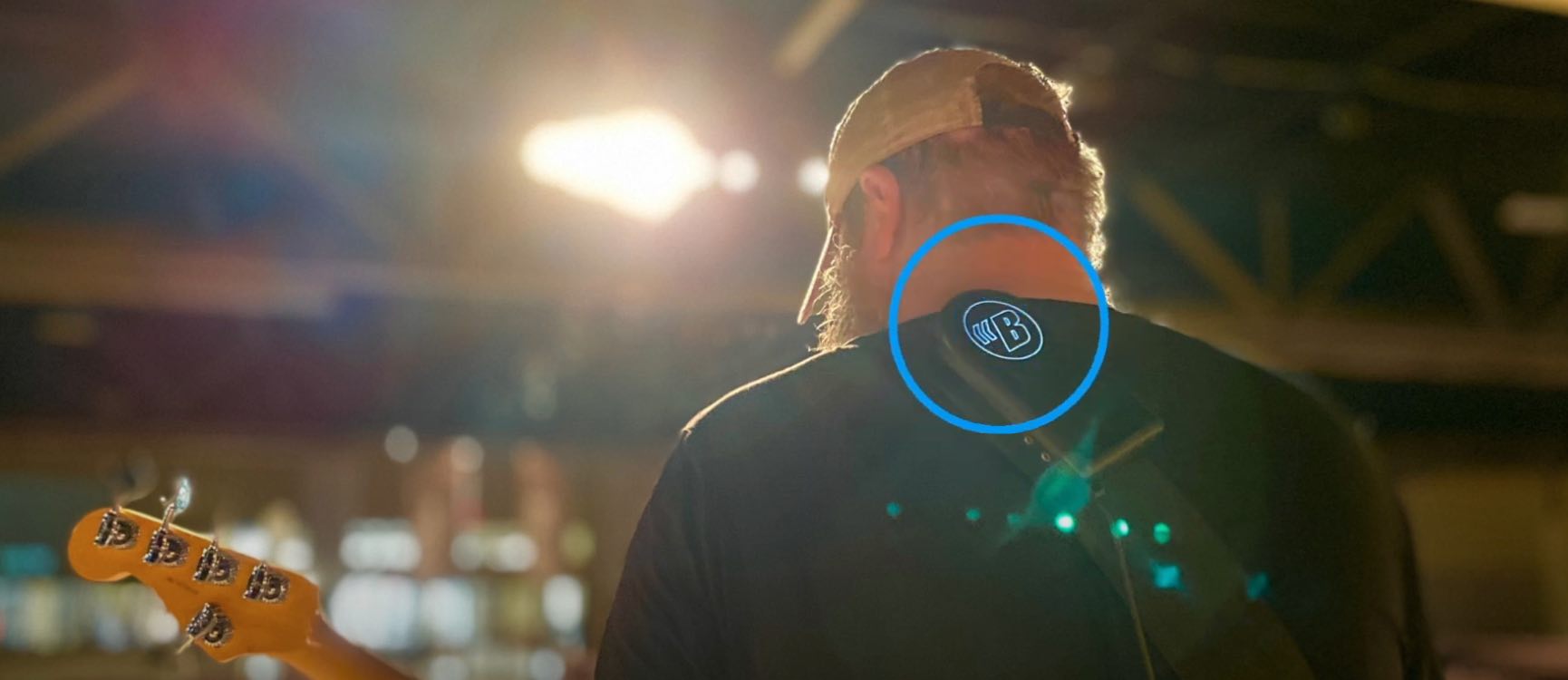
1. Basic Functionality

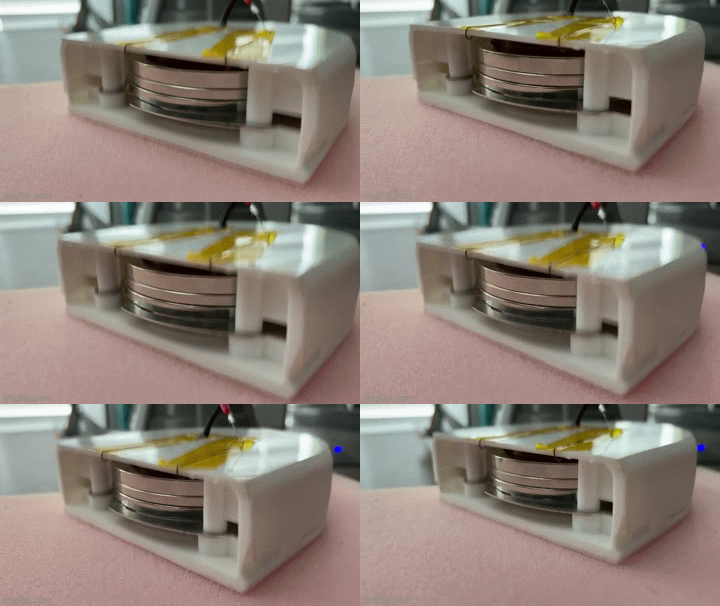
BackBeat is a tactile device with a shaking mass. In principle, it's like a speaker without a cone. If you play the A string on your bass, the moving mass will oscillate 55 times a second. You'll feel this through your body, and your mind will instinctively know you're playing an A.
2. Specifications

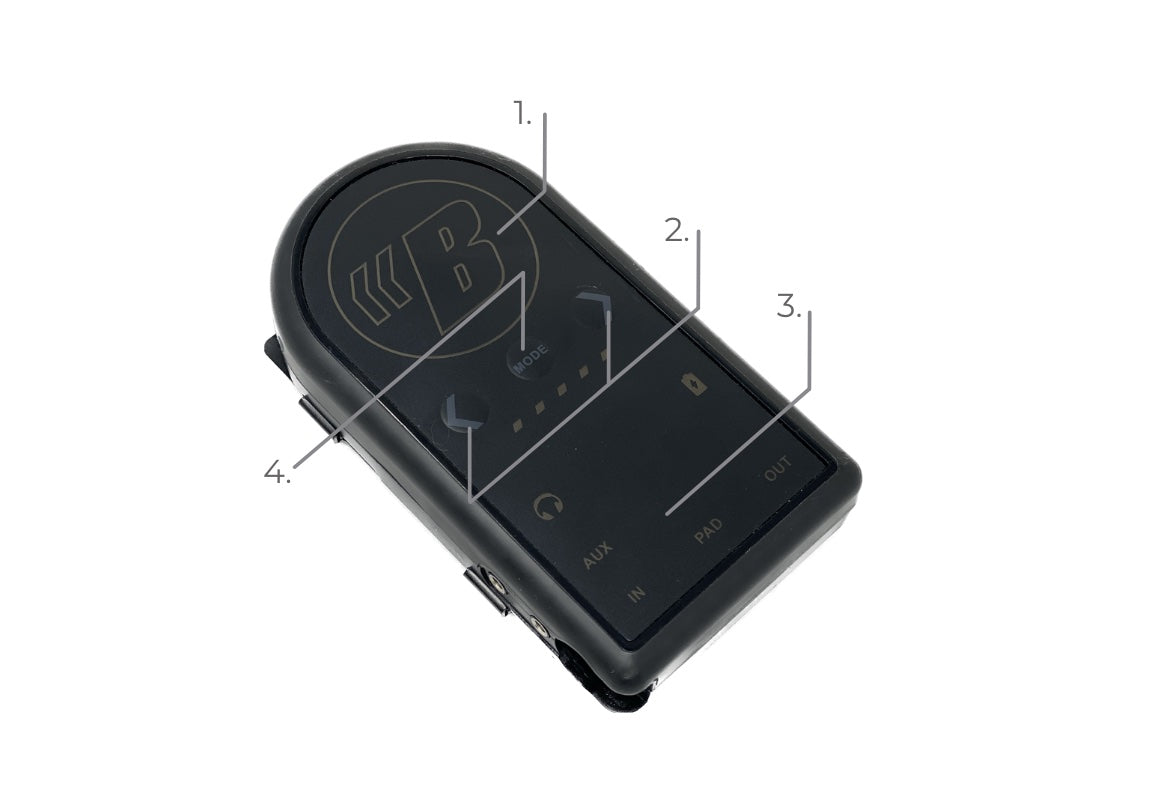
Touchpad Controls
1. On/off button
2. Increment/decrement buttons
3. LED indicators
4. Mode button
______________________________
Dimensions
L = 140mm (5.6in)
W = 75mm (3in)
H = 25mm (1in)
Weight = 310g ( 11oz)

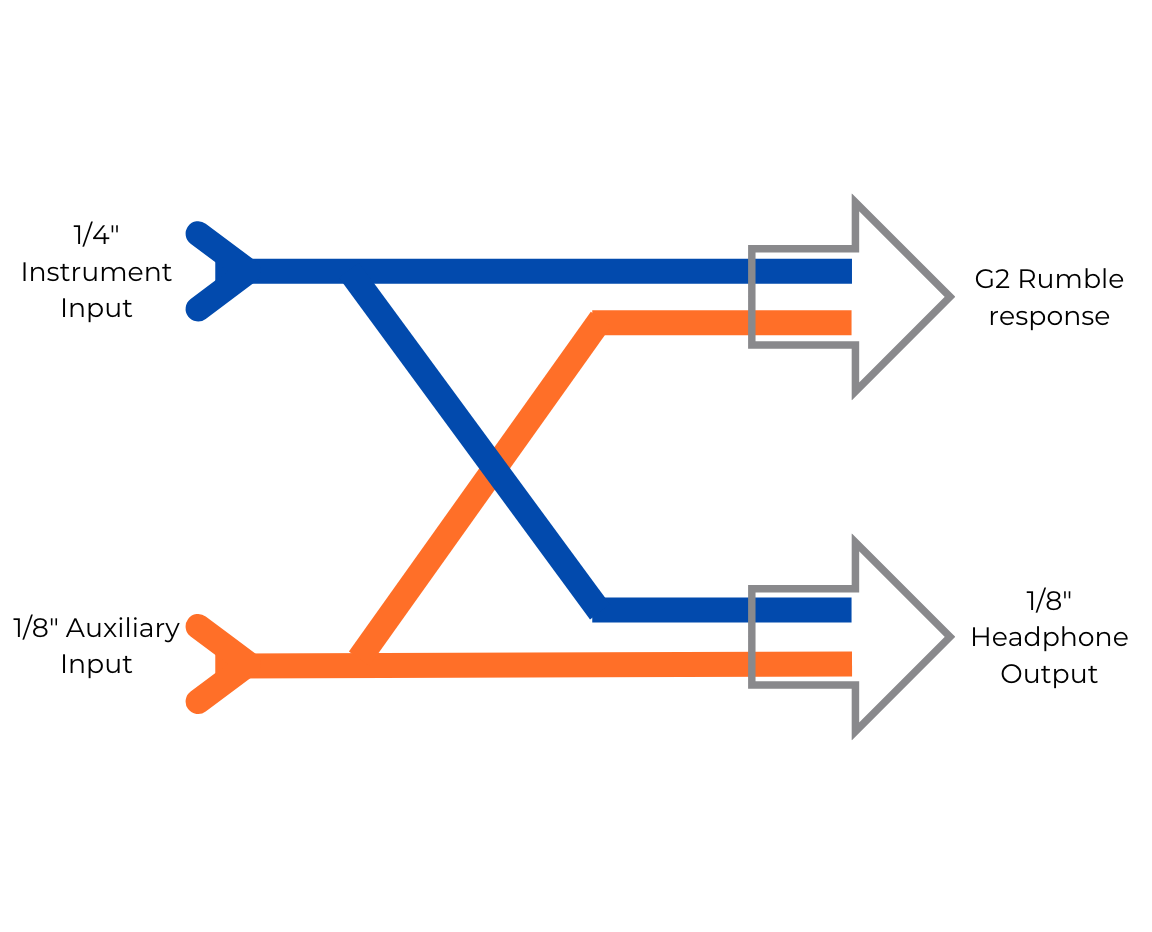
G2 has 2 inputs; a 1/4" mono instrument input and 1/8" stereo Auxiliary input.
The 2 outputs are the rumble response and Headphone output.
The G2 touchpad control allows these outputs to be independently mixed and controlled from mute to max rumble/volume. See the Touchpad video for more details.

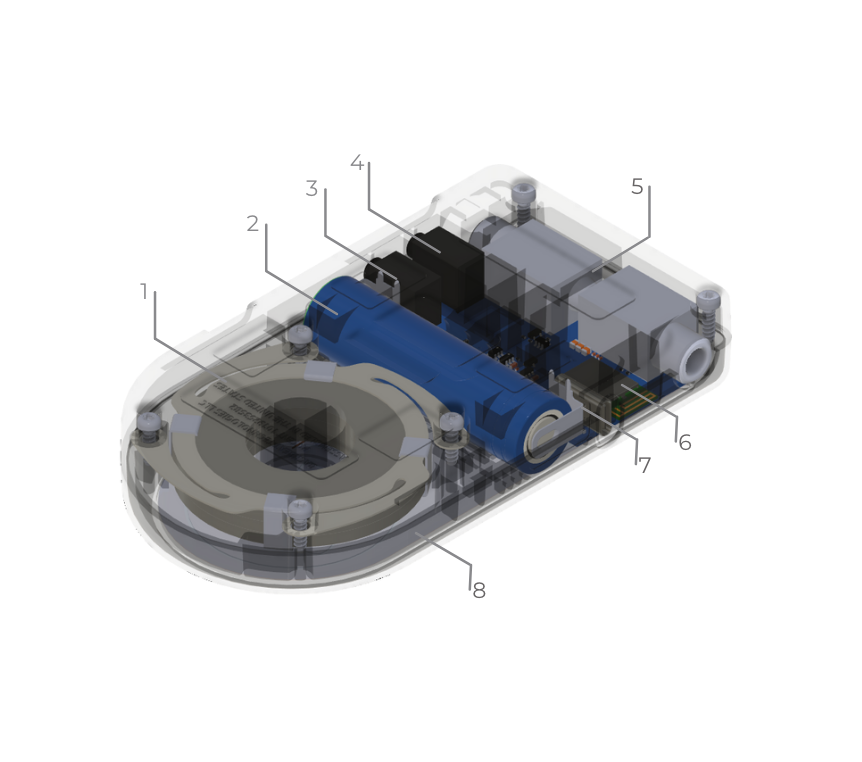
1. Motor
N52 magnet
heat treated steel spring
insulated copper wire voice coil
20-180Hz response
______________________________
2. Rechargeable battery
3.7V 3000mAh 18650 Li-Ion battery
3-5 hours usage, longer at lower intensity
1-2 hours recharge
Replaceable with basic tools, not designed for quick swaps
______________________________
3. Headphone output
1/8" TRS jack
20-20kHz response
______________________________
4. Auxiliary input
1/8" TRS jack
______________________________
5. Instrument input/through
1/4" TS Neutrik jacks
1Mohm input impedance
______________________________
6. Bluetooth
nRF52 Bluetooth module
______________________________
7. USB-C
5V USB-C charging connector
______________________________
8. enclosure
ABS+PC engineered thermoplastic
TPE Durometer rubber edge
3. Configurations

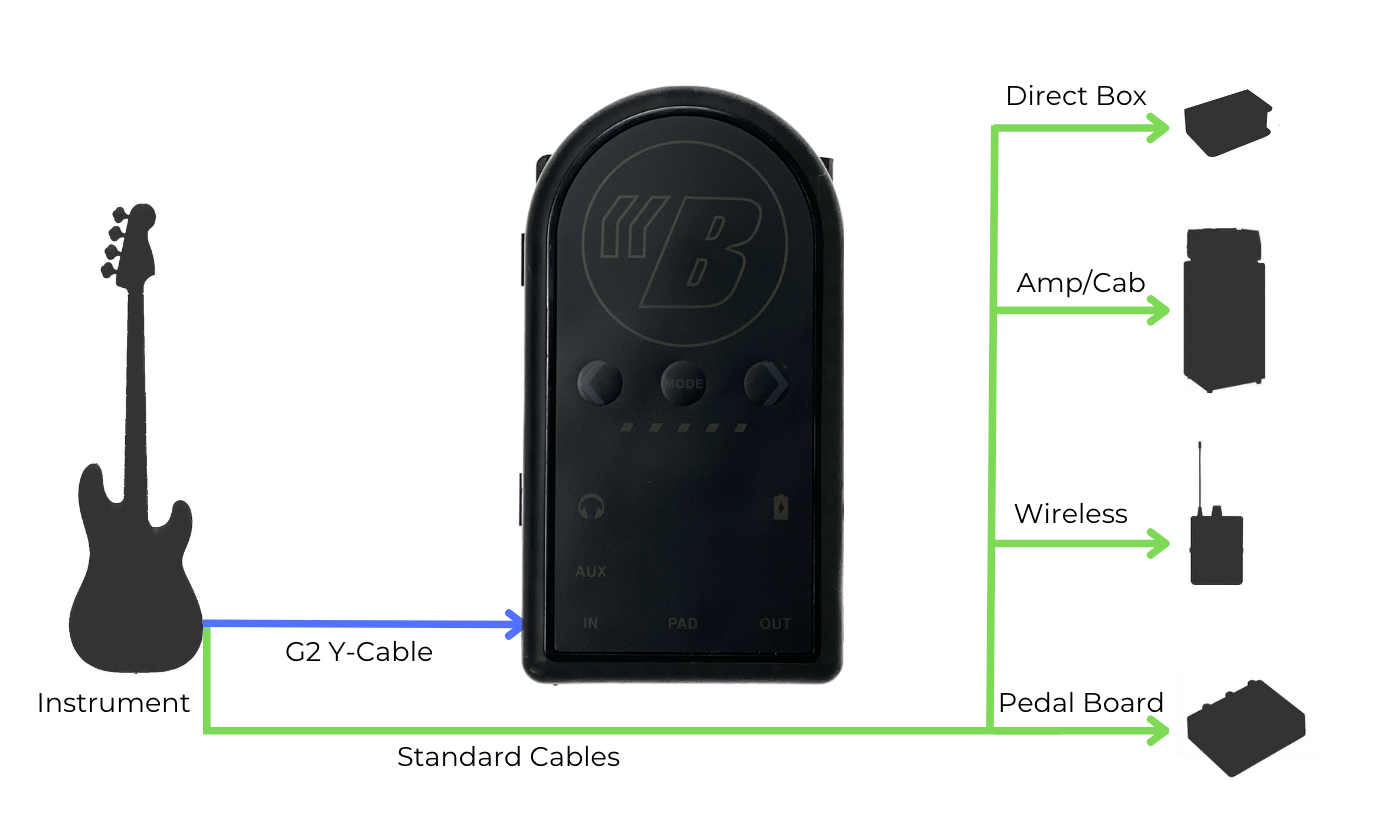
Standard Configuration
BackBeat G2 signal path is shown in the above schematic using the provided Custom G2 Cable.

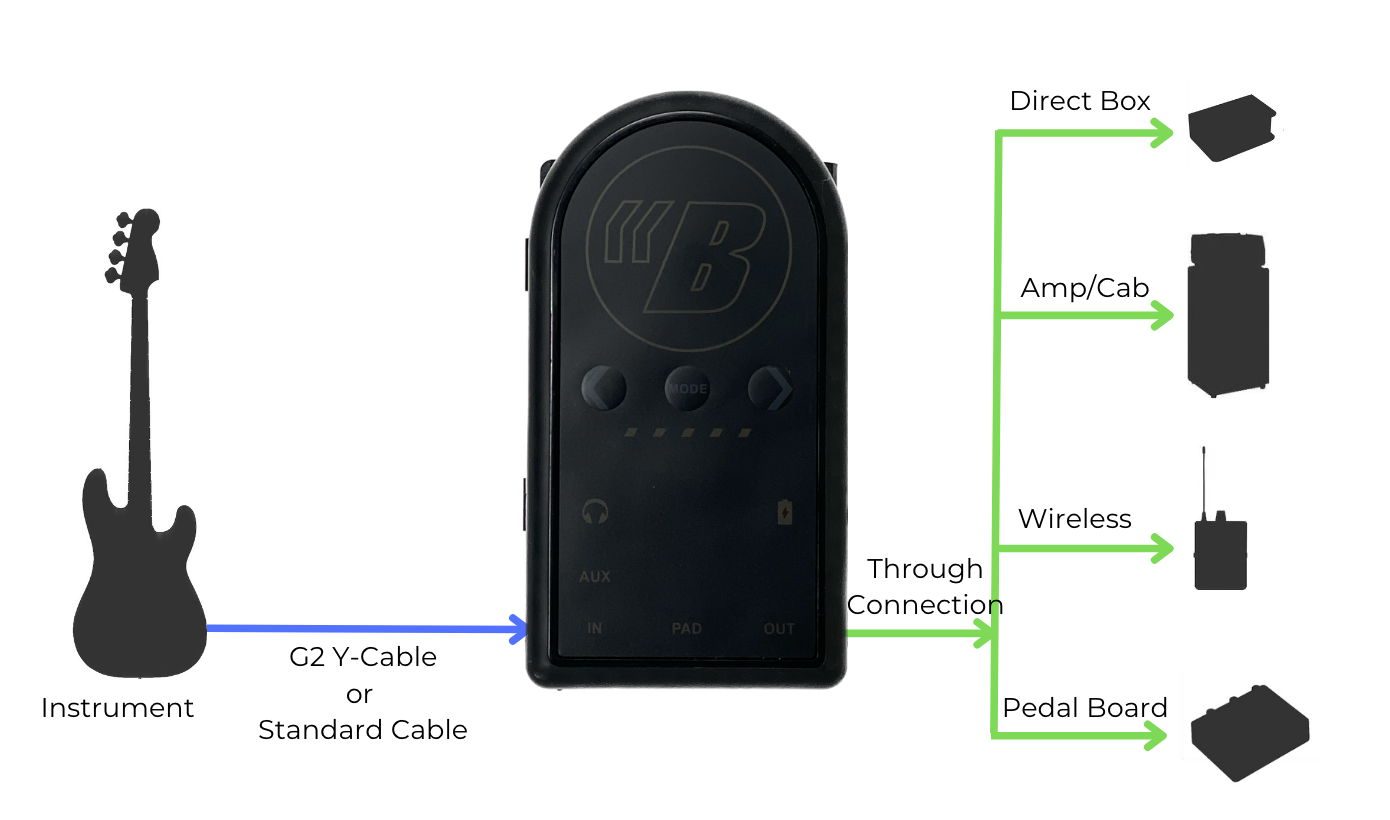
Standard Configuration - Through
This is the same as the Standard Configuration except its using the Through jack on the G2. In this configuration you can use any cable you like.

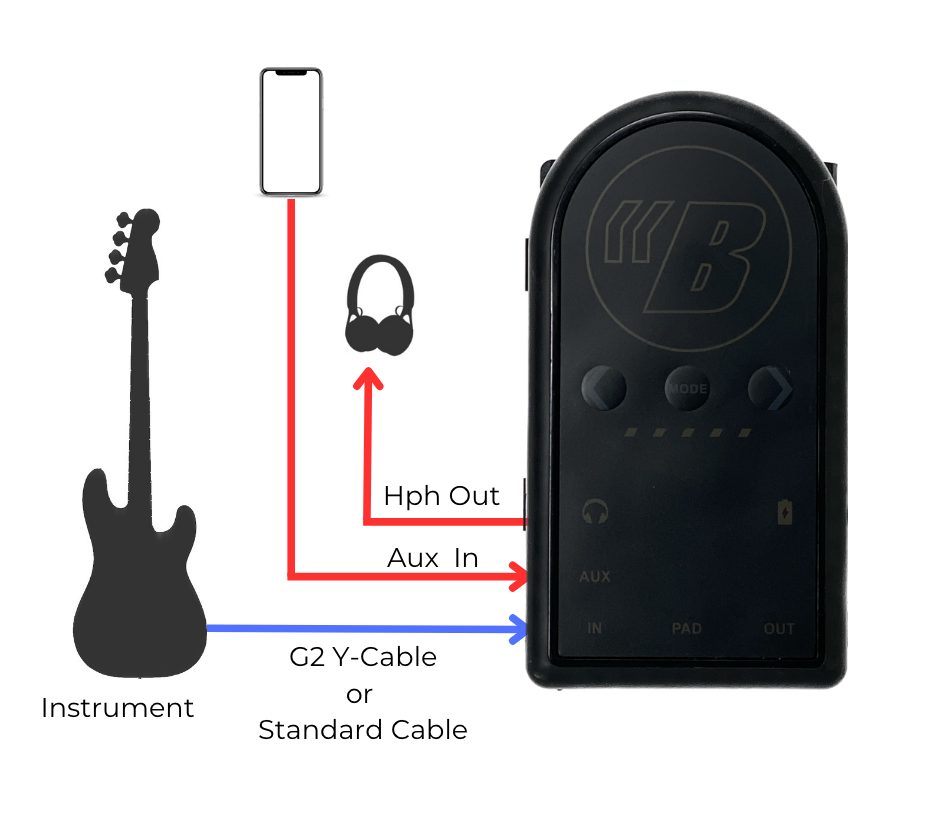
Practice
In this configuration you're able to use G2 for practice. Play a song from your phone and play along with your Instrument. You can chose to mix the Headphone output with or without the mixed Rumble response.

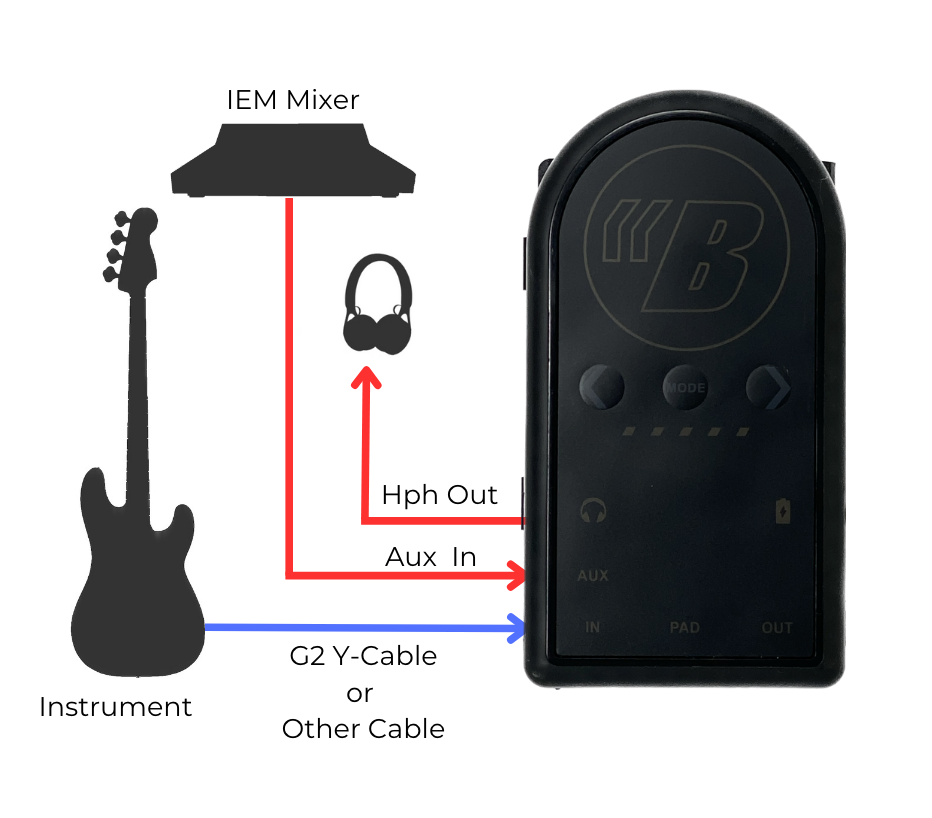
IEM Configuration
You can send your entire IEM mix to the G2. The stereo headphone output maps to the TRS Auxiliary input.
4. Control


Control your BackBeat G2 wirelessly via Bluetooth, out now on iOS and Android. Click on the button to download from the App Store
With control from your phone you can make changes on the fly:
-slider/knob control for volume and rumble.
-pad control.
-battery status.


BACKBEAT G2 FEATURES
Frequently Asked Questions
Why can't I feel my bass on stage?
If you're on in-ear monitors or a silent stage, the notes are in your ears but your body gets nothing. IEM drivers are too small to move air the way a bass cabinet does. Without that physical push, your playing feels flat. You hear the note but you don't feel it land. The BackBeat G2's motor converts your bass signal into physical vibration through your strap, recreating that sensation directly through your body without adding any stage volume.
I can hear my bass through my IEMs but it doesn't feel right. What's missing?
The physical feedback. When you stand in front of a bass amp, you don't just hear the note, you feel it in your chest and back. IEMs deliver the audio perfectly but strip out the physical dimension. Your ears say the note is there; your body says it isn't. That disconnect changes your touch, your dynamics, and your confidence on stage. The G2 restores the feel by converting your instrument signal into vibration you feel through your strap. Plug your bass into the G2, run IEMs from your monitor system, and the physical feedback stays with you no matter where you stand on stage.
Does the BackBeat G2 work with a wireless system?
Yes. The G2 has a signal-through jack, so it sits in your chain without interrupting anything downstream. The usual placement is bass into the G2's 1/4" instrument input, then out of the signal-through jack into your wireless transmitter, so the G2 sees your instrument directly and everything after it is unchanged. Mark Damon of The Pretty Reckless runs exactly that order: bass, then G2 on the strap, then wireless, then amp and front of house.
Putting the G2 first has a practical advantage. Because it is on your body and your bass is on your body, that cable never has to reach the floor, so going wireless after it keeps you genuinely untethered. You can also run it from a wireless receiver instead if that suits your rig better. Either way it draws no power from your signal and passes it through unaffected, so leaving it connected when it is switched off changes nothing about your sound.
Do tactile feedback devices improve timing and groove for bass players?
Many players report that they do, and the reason is straightforward. Locking in with a drummer is not purely a listening task. On a loud stage with a cabinet behind you, part of how you find the pocket is physical: you feel the attack of your note against the kick drum, and you feel when the two line up. In-ear monitors deliver both signals to your ears but strip out that physical layer, so timing becomes something you judge by ear alone.
A wearable tactile transducer puts the physical layer back. You feel your own attack rather than only hearing it, which makes it easier to sense when you are pushing ahead of the beat or sitting behind it. Feed the monitor mix into the G2's aux input and you feel bass and kick together, which is the closest thing to standing in front of a rig next to the drum riser. Players describe it as their whole chest resonating with the groove, and being able to feel when they are in the pocket rather than having to work it out.
It also affects touch, which affects time. When you cannot feel a note land, your right hand tends to dig in harder to confirm it. That extra effort makes dynamics blunter and phrasing less precise. With the physical confirmation there, the hand relaxes and note length, articulation, and placement get easier to control.
Can BackBeat help if I have hearing loss?
It can, though not in the way a hearing aid does. BackBeat is not a medical device and it does nothing to what you hear. What it does is give you a channel that doesn't depend on your ears at all. Your bass signal becomes physical vibration you feel through your body, detailed enough to carry attack, note length, articulation, and pitch movement. Players describe feeling when they are locked in with the drummer, and feeling the difference between a light touch and a hard one. For a player whose hearing is carrying more of the load than it used to, that is a parallel route to the same information. Bassists use the G2 for this reason on loud stages and quiet ones, with an amp or without, with in-ear monitors or with hearing aids in.
Does BackBeat help protect my hearing?
Indirectly. Bassists who can't feel their instrument tend to push their in-ear mix louder to compensate, which drives more volume straight into their ears. BackBeat supplies the physical side with no additional decibels, which removes the reason to chase volume in the first place. It adds nothing to stage volume either, since it is tactile only and silent to the room.
Why am I digging in so hard on my bass?
If you're on in-ears or a silent stage, you're probably digging in because you can't feel the note land. Your hands are overworking to confirm what your body isn't getting. The standard advice ("turn up and play lighter") doesn't work when there's no amp to turn up. The G2 gives your body the physical confirmation that the note is there, so your hands can relax. The motor responds to dynamics across the full range of the instrument, from a whisper to full attack, so you feel the difference between a light touch and a hard dig. Players consistently report lighter touch, better dynamics, and less fatigue once the feel is back.
Can I practice bass at home without disturbing anyone?
Yes. Plug your bass into the G2's 1/4" instrument input, connect headphones to the headphone output, and practice with full physical feedback at zero volume to the room. You feel every note through your body the way you would on stage, but nobody else hears a thing. The aux input also lets you play along with tracks from your phone or tablet while feeling both signals blended through the G2. It's closer to the real playing experience than headphones alone, where everything feels thin and disconnected.